
A new paper led by Dr. Pierrat is out now in Geophysical Research Letters. “OCO-3 Meets ECOSTRESS: Insights Into Ecosystem Diurnal Water-Use Efficiency From Co-Located Solar-Induced Fluorescence and Thermal Observations,” written with colleagues at NASA’s Jet Propulsion Laboratory, Chapman University, CESBIO, and Northern Arizona University, asks whether two instruments on the International Space Station can track how ecosystems trade water for carbon over the course of a day.
Plants take up carbon dioxide and lose water through the same pores, their stomata, so carbon uptake (gross primary production, GPP) and water loss (evapotranspiration, ET) are tightly linked. Their ratio, water-use efficiency (WUE), is a key indicator of how ecosystems respond to heat, drought, and rising CO2. WUE also changes a lot within a single day: as temperatures and evaporative demand climb toward midday, stressed plants close their stomata and carbon uptake and water loss can come apart. Most satellites pass over at the same local time every day, so they miss these sub-daily dynamics.
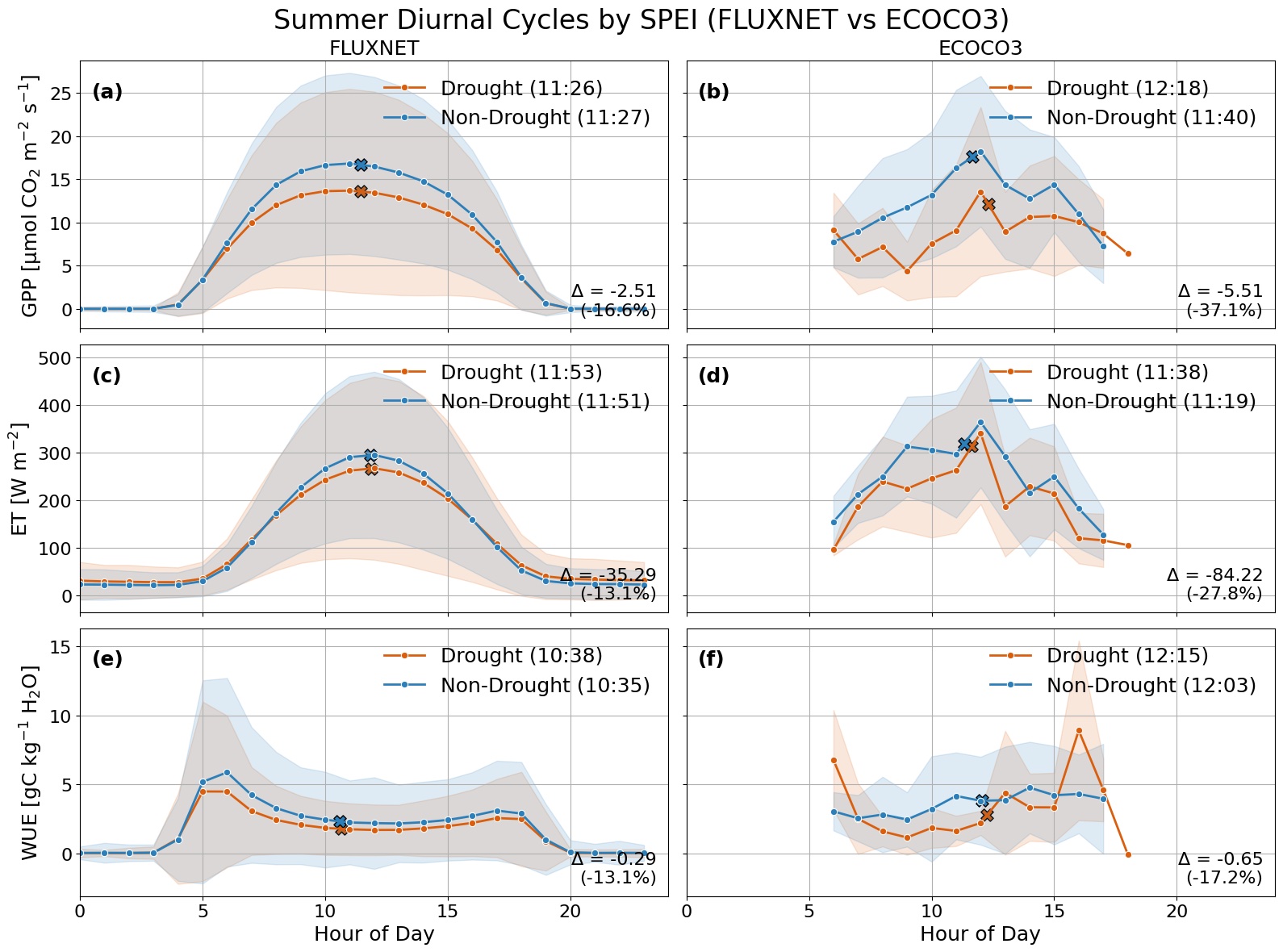
The International Space Station’s precessing orbit is different. It passes over a given location at different times of day, so instruments on board can sample the full daytime cycle. The study combines two of them: NASA’s Orbiting Carbon Observatory-3 (OCO-3), which measures solar-induced chlorophyll fluorescence (SIF), a proxy for photosynthesis, and ECOSTRESS, whose thermal observations are used to estimate ET. The team built ECOCO3, a dataset that matches OCO-3 and ECOSTRESS observations in space and time, and compared the satellite-based carbon and water fluxes with eddy covariance measurements from FLUXNET towers across vegetation types, climates, and drought conditions.
ECOCO3 captures the broad seasonal and diurnal patterns of carbon and water exchange, including midday drought responses. The comparison also exposes the limits of current products: SIF-based GPP tends to run low and ECOSTRESS ET tends to run high, and because WUE is a ratio, these opposing biases add up, shifting the timing of the satellite-derived WUE cycle later in the afternoon than the towers show. Viewing geometry matters too, since the angle between the sun, the canopy, and the sensor affects both the SIF and thermal signals. Measuring carbon and water from the same platform at the same moment partly cancels those effects in WUE. A sampling sensitivity analysis shows that the main thing keeping ECOCO3 from separating vegetation- and climate-driven differences in WUE is the number of available co-located observations.
The results point to clear next steps for sub-daily carbon–water monitoring from space: more co-located fluorescence and thermal observations, smaller opposing biases in carbon and water products, and corrections for viewing-angle effects. They also bear on future missions such as the planned Surface Biology and Geology (SBG) thermal instrument. The ECOCO3 dataset used in this study is publicly available through the NASA GES DISC (doi.org/10.5067/JY21I1T22RCA), and an updated Version 2.0, based on ECOSTRESS Collection 2 and OCO-3 Version 11.2 and covering August 2019 through June 2026, is now available as well (doi.org/10.5067/UWL1Q909EOZ8).
Pierrat, Z. A., Kurosu, T. P., Chatterjee, A., Fisher, J. B., Johnson, M., Kuai, L., Mallick, K., Parazoo, N., Wiebe, B., & Cawse-Nicholson, K., 2026. OCO-3 meets ECOSTRESS: Insights into ecosystem diurnal water-use efficiency from co-located solar-induced fluorescence and thermal observations. Geophysical Research Letters, 53(18), e2026GL124105. doi.org/10.1029/2026GL124105